
Objects
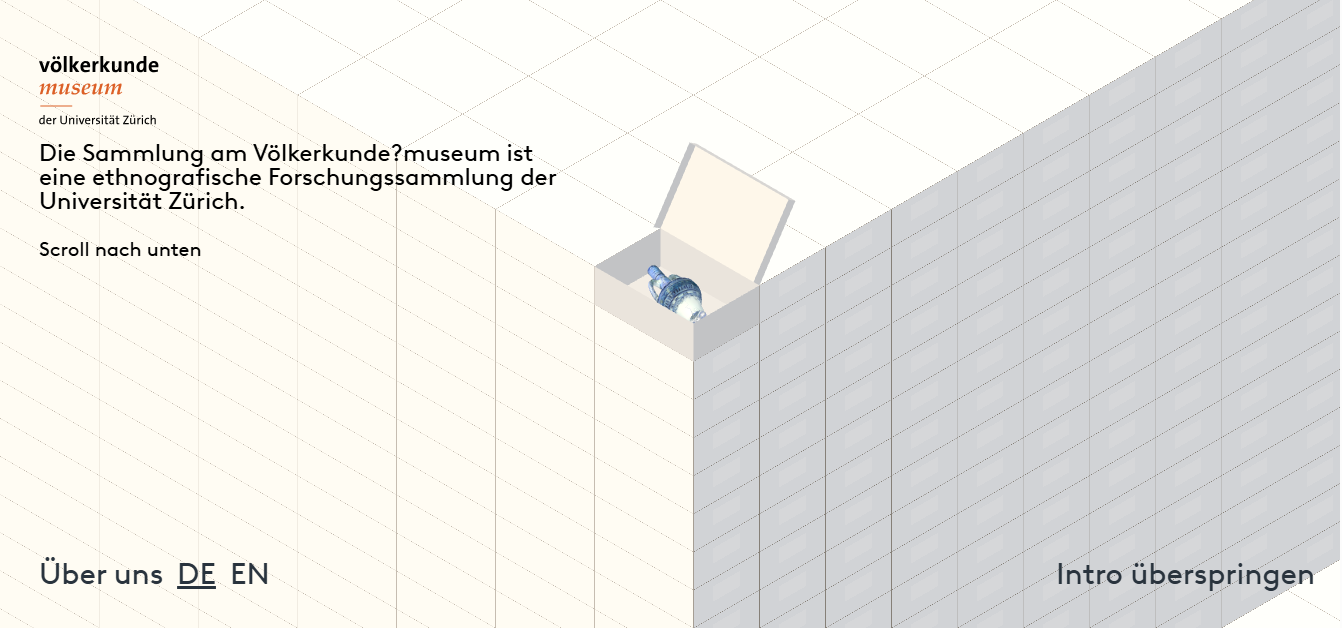
The data visualisation "Box by Box" provides an overview of the objects currently in our collections along with their provenance.
The following texts give an insight into the collections by continent.
Asia
The Asian collection, which accounts for 56% of the museum's holdings, represents the largest part of the collection and is very diverse. This focus developed over time and is closely linked to the museum’s regional orientation and acquisition history. Of the seven directors who served between 1888 and 2025, five conducted research on Asia. In a broader context, this strong focus on Asia reflects society's interest in the entanglements between Asia and Europe in the 20th century. The Department of Social and Cultural Anthropology at the University of Zurich, founded in 1971, likewise continues to maintain a regional focus on Asia.
Africa
The African holdings account for 18% of the museum's collections. More than 60% of these objects were obtained during the colonial period.
The composition of the African collections reflects the interests of European collectors and their perceptions of Africa, which have changed over time. As a result, the early collections contain many objects that were considered "typical" of the way of life of African societies, such as household items, weapons, or clothing. With the growing interest of European elites in "African art" during the mid-20th century, museums and collectors increasingly acquired objects that fit this canon, including figures and masks that in their original contexts formed part of religious or political practices.
Americas
15% of the museum's collections originate from the Americas. There are regional focuses in the collections relating to the Inuit in Greenland, the Lakota in South Dakota (USA), the Maya in Guatemala, and the Saamaka in Suriname, as well as various communities in Colombia, the Alto Xingu region of Brazil, and the lowlands of Ecuador and Peru.
From the founding of the ethnographic teaching collection in 1888 until the 1970s, the proportion of holdings from the Americas in the collections increased steadily. Until recently, the museum continued to acquire collections assembled primarily by private Swiss collectors during the 20th century. Some of the new objects result from recent collaborations with source communities.
Oceania
The Oceania collections account for 6% of the museum's holdings. Most of the objects originate from Papua New Guinea, as well as from the Solomon Islands, Vanuatu, and New Caledonia in eastern Melanesia. These regional focuses could likely be explained in greater detail through further provenance research.
The Australian collections make up another significant part of the Oceania collections. One reason for this was a deal between the National Museum in Melbourne and the Swiss National Museum in Zurich: in 1926, a collection from Australia was exchanged for archaeological objects from Swiss pile dwellings. The Swiss National Museum subsequently transferred these to the "Sammlung für Völkerkunde" (Ethnographic Collection) in 1927.
Europe
The European collection is the smallest with just 3% of the museum's holdings. This reflects the historical development of social anthropology in Europe. The discipline primarily focused on non-European societies and was closely intertwined with European colonial expansion. As a result, non-European collections predominate in most ethnographic museums in Europe, whereas material from Europe was more commonly assigned to folklore studies or regional cultural history collections.